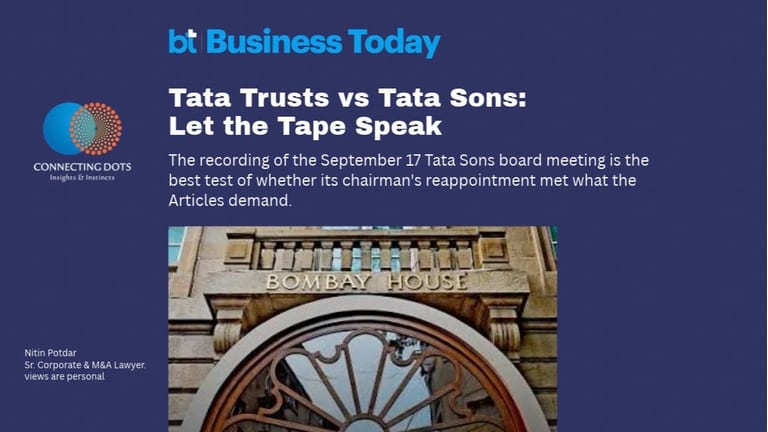
The recording of the September 17 Tata Sons board meeting is the best test of whether its chairman’s reappointment met what the Articles demand.
India Inc. has learnt this the hard way: a board can take the right decision in the wrong manner, and the manner can hurt its reputation far more than the decision ever could. Tata Sons is learning this now.
On September 17, its board reappointed N. Chandrasekaran as executive chairman for five more years by a disputed majority. Noel Tata, chairman of Tata Trusts, voted against the resolution and called it illegal. Who should lead TATA SONS LIMITED is not my concern. The route taken is. If the facts in Noel Tata’s latest letter of 26th October are correct, there were six wrong turns on that route.
One: the agenda never said it
Item 7 read “debriefing from nomination and remuneration committee”. Even the revised agenda was silent on the reappointment. A first-year law or CS student would not make this mistake.
A debriefing is a report. An appointment is a decision. The same agenda flagged that incentive plans needed approval under Article 121. The chairman’s appointment deserved no less.
Secretarial Standard-1 allows an item outside the agenda, with the consent of a majority of directors present. That window is for urgent business, not a back door for appointing the group chairman.
Two: no selection committee
Article 118 provides for a selection committee to choose the chairman. The Trusts sought one on August 13. It was never formed. However unanimous it was, the NRC’s recommendation cannot replace a step that the Articles make compulsory. That step was followed for the same chairman’s two earlier appointments.
Three: numbers are not enough
Articles 118 and 121 require the affirmative vote of the directors nominated by the Trusts under Article 104B. The same chairman has honoured this requirement before. It is a legal right conferred on the Trusts by the Articles in recognition of their two-thirds ownership. On Noel Tata’s reading, with a Trust nominee voting no, the requirement was not met.
Four: conditional, yet final
Noel Tata says the resolution was put to vote subject to conditions that remain unfulfilled. A conditional resolution is a promise, not a decision. Until they are met, nothing can be acted upon, let alone filed.
Five: filed before the minutes
A certified copy is in the media, and the resolution has reportedly been filed with the RoC. Yet Noel Tata says the minutes are not even final. How can a resolution be certified before its minutes are signed? When its very passage is disputed, certifying and filing it dresses up a contested act as a concluded one. Settle the minutes first. File later.
Six: a conflict unaddressed
It has been widely reported in the press that there were alleged dealings between TVS Motor and Hanno One Warehousing, which is said to be linked to Chandrasekaran’s family. Venu Srinivasan of TVS Motor, a Trust-nominated director, sits on the NRC that recommended the reappointment. The letter says that neither of them recorded a disclosure.
I make no finding; there may be a complete answer. But the Tata code of conduct requires any conflict, including a family member’s interest, to be reported at once. That question needed an answer before the vote, not after.
Play the tape
The most important document in this dispute is not a legal opinion but the recording. Noel Tata first asked for it on 30 September. Four weeks later, he is still asking for it and now seeks confirmation that the original has been preserved. That he must ask at all says a great deal.
When directors join by video, the law requires the proceedings to be recorded so that disputes are settled by facts, not competing versions. The tape will show whether consent was obtained for an item outside the agenda, who voted which way, and under what conditions. If all was in order, it is Tata Sons’ best witness. Why hold it back?
Instead, the company relies on opinions from eminent former judges obtained after the meeting. An opinion is only as good as the facts on which it is based. The tape contains the facts. Release it unedited.
Why the tearing hurry?
The current term had five months to run. But urgency is a reason to run the process faster, not to run around it. The haste with which opinions were obtained, and the resolution was passed, raises serious questions of governance. In my view, a resolution passed without meeting the mandatory requirements of the Articles is bad in law and cannot stand.
What now?
A decision meant to bring stability has instead brought a dispute, with the world watching. The remedy lies with the board. Release the recording.
Call a fresh meeting with proper notice. Form the selection committee as per Art 118. Table all papers, including the TVS disclosures. Then seek the vote that the Articles require as per 121. The right choice will survive that process.
After the first board meeting on this matter, I said: settle it at Bombay House, not at the Bombay High Court. I say it again. Do not drag the group into public debate and bitter litigation. That is not the Tata way. If the chairman and the board members truly care for the group, now is the time to show it.
Bombay House has set the standard for Indian boardrooms for a century. It should not now become the textbook case of how not to do it.
— Nitin
Connecting Dots — every fortnight, I take a deal, a policy, or a person and tell you the thinking behind it. Insights and instincts.